|
libwebsockets
Lightweight C library for HTML5 websockets
|
|
libwebsockets
Lightweight C library for HTML5 websockets
|
Data Structures | |
| struct | lws_proxy_v2 |
Macros | |
| #define | LWS_PROXY_V2_MAX (16 + 512) |
Typedefs | |
| typedef struct lws_proxy_v2 | lws_proxy_v2_t |
Functions | |
| LWS_VISIBLE LWS_EXTERN int | lws_proxy_v2_header_len (const uint8_t *buf, size_t len) |
| LWS_VISIBLE LWS_EXTERN int | lws_proxy_v2_parse (const uint8_t *buf, size_t len, lws_proxy_v2_t *pv) |
| LWS_VISIBLE LWS_EXTERN int | lws_proxy_v2_render (const lws_proxy_v2_t *pv, uint8_t *buf, size_t len) |
A proxy that forwards a connection without terminating it, eg, a TLS passthrough, can't add an X-Forwarded-For to what it can't read. Instead, before the client's bytes, it sends the server it connects onward to one binary PROXY v2 header saying who the client is, as haproxy defined it and many servers understand.
Anybody can send one, so a server must only believe one at the very start of a connection from a proxy it trusts, and at most one per connection: anything later is just the client's data. These helpers only render and parse the header; that policy is the caller's.
We render and accept TCP or UDP over IPv4 or IPv6, and LOCAL (the proxy's own connection, eg, a health check, which carries no addresses). Of the TLVs, we render and report PP2_TYPE_ALPN and PP2_TYPE_AUTHORITY (the name the client asked for, eg, its TLS SNI), verify PP2_TYPE_CRC32C if it is present, and skip the others.
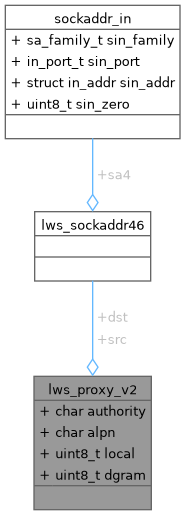
| struct lws_proxy_v2 |
Definition at line 50 of file lws-proxy-v2.h.
| Data Fields | ||
|---|---|---|
| lws_sockaddr46 | src |
the client, as the proxy saw it |
| lws_sockaddr46 | dst |
what the client connected to |
| char | authority[256] |
PP2_TYPE_AUTHORITY, eg, the client's TLS SNI name, or "" |
| char | alpn[64] |
PP2_TYPE_ALPN, or "" |
| uint8_t | local |
LOCAL: no addresses, the proxy's own connection |
| uint8_t | dgram |
the client's connection is UDP |
| #define LWS_PROXY_V2_MAX (16 + 512) |
#include <lws-proxy-v2.h>
Definition at line 48 of file lws-proxy-v2.h.
| typedef struct lws_proxy_v2 lws_proxy_v2_t |
#include <lws-proxy-v2.h>
| LWS_VISIBLE LWS_EXTERN int lws_proxy_v2_header_len | ( | const uint8_t * | buf, |
| size_t | len ) |
#include <lws-proxy-v2.h>
lws_proxy_v2_header_len() - how long the PROXY v2 header at buf is
| buf | the first bytes of the connection |
| len | how many of them there are |
Returns the length of the whole header if buf starts with the PROXY v2 signature and enough of a header to say how long it is, 0 if more bytes are needed to know, or -1 if it is not a PROXY v2 header, or one longer than LWS_PROXY_V2_MAX.
References LWS_EXTERN, and LWS_VISIBLE.
| LWS_VISIBLE LWS_EXTERN int lws_proxy_v2_parse | ( | const uint8_t * | buf, |
| size_t | len, | ||
| lws_proxy_v2_t * | pv ) |
#include <lws-proxy-v2.h>
lws_proxy_v2_parse() - parse one whole PROXY v2 header
| buf | the header |
| len | its length, as lws_proxy_v2_header_len() gave it |
| pv | filled in with what the header says |
Everything in the header is untrusted until the caller has decided to trust where it came from, and is checked as such: the version, command and address family must be ones we accept, the address block and every TLV must fit exactly, an authority or alpn must be printable and fit, neither may appear twice, and a CRC32C TLV must match.
Returns 0 if the header is valid, else -1.
References LWS_EXTERN, and LWS_VISIBLE.
| LWS_VISIBLE LWS_EXTERN int lws_proxy_v2_render | ( | const lws_proxy_v2_t * | pv, |
| uint8_t * | buf, | ||
| size_t | len ) |
#include <lws-proxy-v2.h>
lws_proxy_v2_render() - render a PROXY v2 header
| pv | what the header should say. src and dst must be of the same family, unless local is set; IPv4-mapped IPv6 addresses count as IPv4, so a pair of them, or one with an AF_INET address, is rendered as TCP4 / UDP4. Empty authority or alpn are left out. |
| buf | where to render it |
| len | the space at buf |
Returns the length of the header rendered, or -1 if it did not fit or pv can't be rendered.
 1.18.0