|
libwebsockets
Lightweight C library for HTML5 websockets
|
|
libwebsockets
Lightweight C library for HTML5 websockets
|
Topics | |
| Vhost mounts and options | |
Data Structures | |
| struct | lws_context_creation_info |
| struct | lws_lejp_conf_defs |
| struct | lws_protocol_vhost_options |
Typedefs | |
| typedef int(* | lws_context_ready_cb_t) (struct lws_context *context) |
| typedef uint64_t(* | lws_quic_tx_credit_cb_t) (struct lws *wsi, uint64_t current_window, uint64_t consumed_bytes, uint64_t time_since_last_update_us) |
| typedef int(* | lws_reload_func) (void) |
Functions | |
| LWS_VISIBLE LWS_EXTERN struct lws_context * | lws_create_context (const struct lws_context_creation_info *info) |
| LWS_VISIBLE LWS_EXTERN void | lws_context_destroy (struct lws_context *context) |
| LWS_VISIBLE LWS_EXTERN void | lws_tls_cleanup_process (void) |
| LWS_VISIBLE LWS_EXTERN void | lws_context_deprecate (struct lws_context *context, lws_reload_func cb) |
| LWS_VISIBLE LWS_EXTERN int | lws_context_is_deprecated (struct lws_context *context) |
| LWS_VISIBLE LWS_EXTERN int | lws_set_proxy (struct lws_vhost *vhost, const char *proxy) |
| LWS_VISIBLE LWS_EXTERN int | lws_set_socks (struct lws_vhost *vhost, const char *socks) |
| LWS_VISIBLE LWS_EXTERN struct lws_vhost * | lws_create_vhost (struct lws_context *context, const struct lws_context_creation_info *info) |
| LWS_VISIBLE LWS_EXTERN void | lws_vhost_destroy (struct lws_vhost *vh) |
| LWS_VISIBLE LWS_EXTERN int | lwsws_get_config_globals (struct lws_context_creation_info *info, const char *d, char **config_strings, int *len) |
| LWS_VISIBLE LWS_EXTERN int | lwsws_get_config_globals_defs (struct lws_lejp_conf_defs *defs, struct lws_context_creation_info *info, const char *d, char **config_strings, int *len) |
| LWS_VISIBLE LWS_EXTERN int | lwsws_get_config_vhosts (struct lws_context *context, struct lws_context_creation_info *info, const char *d, char **config_strings, int *len) |
| LWS_VISIBLE LWS_EXTERN int | lwsws_get_config_vhosts_defs (struct lws_lejp_conf_defs *defs, struct lws_context *context, struct lws_context_creation_info *info, const char *d, char **config_strings, int *len) |
| LWS_VISIBLE LWS_EXTERN struct lws_vhost * | lws_get_vhost (struct lws *wsi) |
| LWS_VISIBLE LWS_EXTERN const char * | lws_get_vhost_name (struct lws_vhost *vhost) |
| LWS_VISIBLE LWS_EXTERN struct lws_vhost * | lws_get_vhost_by_name (struct lws_context *context, const char *name) |
| LWS_VISIBLE LWS_EXTERN struct lws_vhost * | lws_select_vhost_sni (struct lws_vhost *lv, const char *servername) |
| LWS_VISIBLE LWS_EXTERN int | lws_get_vhost_port (struct lws_vhost *vhost) |
| LWS_VISIBLE LWS_EXTERN void * | lws_get_vhost_user (struct lws_vhost *vhost) |
| LWS_VISIBLE LWS_EXTERN const char * | lws_get_vhost_iface (struct lws_vhost *vhost) |
| LWS_VISIBLE LWS_EXTERN void * | lws_vhost_user (struct lws_vhost *vhost) |
| LWS_VISIBLE LWS_EXTERN void * | lws_context_user (struct lws_context *context) |
| LWS_VISIBLE LWS_EXTERN const char * | lws_vh_tag (struct lws_vhost *vh) |
| LWS_VISIBLE LWS_EXTERN void | _lws_context_info_defaults (struct lws_context_creation_info *info, const char *sspol) |
| LWS_VISIBLE LWS_EXTERN void | lws_default_loop_exit (struct lws_context *cx) |
| LWS_VISIBLE LWS_EXTERN void | lws_context_default_loop_run_destroy (struct lws_context *cx) |
| LWS_VISIBLE LWS_EXTERN int | lws_cmdline_passfail (int argc, const char **argv, int actual) |
| LWS_VISIBLE LWS_EXTERN int | lws_systemd_inherited_fd (unsigned int index, struct lws_context_creation_info *info) |
| LWS_VISIBLE LWS_EXTERN int | lws_context_is_being_destroyed (struct lws_context *context) |
LWS requires that there is one context, in which you may define multiple vhosts. Each vhost is a virtual host, with either its own listen port or sharing an existing one. Each vhost has its own SSL context that can be set up individually or left disabled.
If you don't care about multiple "site" support, you can ignore it and lws will create a single default vhost at context creation time.
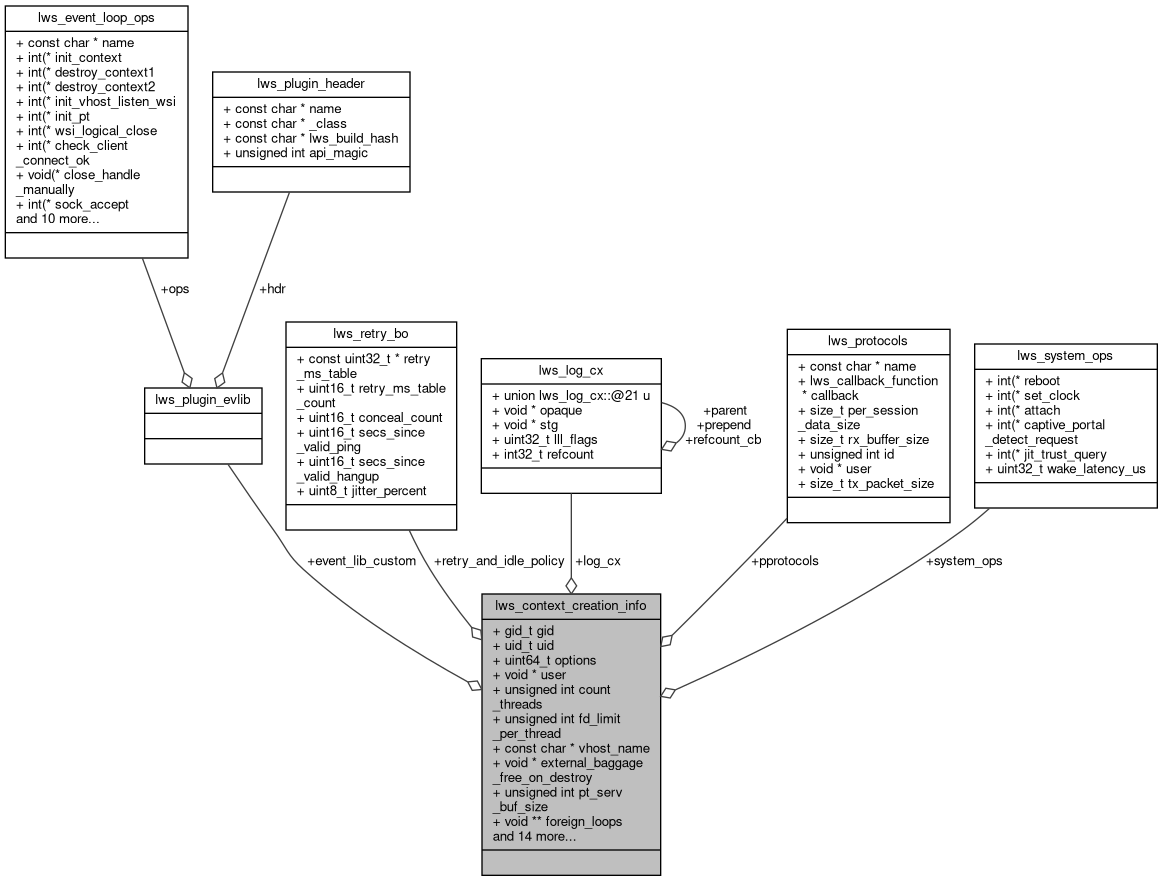
| struct lws_context_creation_info |
Definition at line 441 of file lws-context-vhost.h.
| Data Fields | ||
|---|---|---|
| gid_t | gid |
CONTEXT: group id to change to after setting listen socket, or -1. See also .username below. |
| uid_t | uid |
CONTEXT: user id to change to after setting listen socket, or -1. See also .groupname below. |
| uint64_t | options |
VHOST + CONTEXT: 0, or LWS_SERVER_OPTION_... bitfields |
| void * | user |
VHOST + CONTEXT: optional user pointer that will be associated with the context when creating the context (and can be retrieved by lws_context_user(context), or with the vhost when creating the vhost (and can be retrieved by lws_vhost_user(vhost)). You will need to use LWS_SERVER_OPTION_EXPLICIT_VHOSTS and create the vhost separately if you care about giving the context and vhost different user pointer values. |
| unsigned int | count_threads |
CONTEXT: how many contexts to create in an array, 0 = 1 |
| unsigned int | fd_limit_per_thread |
CONTEXT: nonzero means restrict each service thread to this many fds, 0 means the default which is divide the process fd limit by the number of threads. Note if this is nonzero, and fd_limit_per_thread multiplied by the number of service threads is less than the process ulimit, then lws restricts internal lookup table allocation to the smaller size, and switches to a less efficient lookup scheme. You should use this to trade off speed against memory usage if you know the lws context will only use a handful of fds. The count is the whole table, including the fds lws holds itself (LWS_FD_LIMIT_INTERNAL, the floor a nonzero value is raised to) and the overhead connections carry: set it to LWS_FD_LIMIT_PER_THREAD_MIN plus the connections you will have open at once. A full table stops every listener accepting until a connection closes, logged once per thread at WARN. |
| const char * | vhost_name |
VHOST: name of vhost, must match external DNS name used to access the site, like "warmcat.com" as it's used to match Host: header and / or SNI name for SSL. CONTEXT: NULL, or the name to associate with the context for context-specific logging |
| void * | external_baggage_free_on_destroy |
CONTEXT: NULL, or pointer to something externally malloc'd, that should be freed when the context is destroyed. This allows you to automatically sync the freeing action to the context destruction action, so there is no need for an external free() if the context succeeded to create. |
| unsigned int | pt_serv_buf_size |
CONTEXT: 0 = default of 4096. This buffer is used by various service related features including file serving, it defines the max chunk of file that can be sent at once. At the risk of lws having to buffer failed large sends, it can be increased to, eg, 128KiB to improve throughput. Values below LWS_PRE + 1024 or above LWS_PT_SERV_BUF_SIZE_MAX (16MiB) are clamped to those limits. |
| void ** | foreign_loops |
CONTEXT: This is ignored if the context is not being started with an event loop, ie, .options has a flag like LWS_SERVER_OPTION_LIBUV. NULL indicates lws should start its own even loop for each service thread, and deal with closing the loops when the context is destroyed. Non-NULL means it points to an array of external ("foreign") event loops that are to be used in turn for each service thread. In the default case of 1 service thread, it can just point to one foreign event loop. |
| void(*)(void *event_lib_handle, int signum) | signal_cb |
CONTEXT: NULL: default signal handling. Otherwise this receives the signal handler callback. event_lib_handle is the native event library signal handle, eg uv_signal_t * for libuv. |
| struct lws_context ** | pcontext |
CONTEXT: if non-NULL, at the end of context destroy processing, the pointer pointed to by pcontext is written with NULL. You can use this to let foreign event loops know that lws context destruction is fully completed. |
| void(*)(struct lws_vhost *vh, void *arg) | finalize |
VHOST: NULL, or pointer to function that will be called back when the vhost is just about to be freed. The arg parameter will be set to whatever finalize_arg is below. |
| void * | finalize_arg |
VHOST: opaque pointer lws ignores but passes to the finalize callback. If you don't care, leave it NULL. |
| const char * | listen_accept_role |
VHOST: NULL for default, or force accepted incoming connections to bind to this role. Uses the role names from their ops struct, eg, "raw-skt". |
| const char * | listen_accept_protocol |
VHOST: NULL for default, or force accepted incoming connections to bind to this vhost protocol name. |
| const struct lws_protocols ** | pprotocols |
VHOST: NULL: use .protocols, otherwise ignore .protocols and use this array of pointers to protocols structs. The end of the array is marked by a NULL pointer. This is preferred over .protocols, because it allows the protocol struct to be opaquely defined elsewhere, with just a pointer to it needed to create the context with it. .protocols requires also the type of the user data to be known so its size can be given. |
| const char * | username |
CONTEXT: string username for post-init permissions. Like .uid but takes a string username. |
| const char * | groupname |
CONTEXT: string groupname for post-init permissions. Like .gid but takes a string groupname. |
| const char * | unix_socket_perms |
VHOST: if your vhost is listening on a unix socket, you can give a "username:groupname" string here to control the owner:group it's created with. It's always created with 0660 mode. |
| const lws_system_ops_t * | system_ops |
CONTEXT: hook up lws_system_ apis to system-specific implementations |
| const lws_retry_bo_t * | retry_and_idle_policy |
VHOST: optional retry and idle policy to apply to this vhost. Currently only the idle parts are applied to the connections. |
| int | rlimit_nofile |
0 = inherit the initial ulimit for files / sockets from the startup environment. Nonzero = try to set the limit for this process. |
| int | fo_listen_queue |
VHOST: 0 = no TCP_FASTOPEN, nonzero = enable TCP_FASTOPEN if the platform supports it, with the given queue length for the listen socket. |
| const struct lws_plugin_evlib * | event_lib_custom |
CONTEXT: If non-NULL, override event library selection so it uses this custom event library implementation, instead of default internal loop. Don't set any other event lib context creation flags in that case. it will be used automatically. This is useful for integration where an existing application is using its own handrolled event loop instead of an event library, it provides a way to allow lws to use the custom event loop natively as if it were an "event library". |
| lws_log_cx_t * | log_cx |
CONTEXT: NULL to use the default, process-scope logging context, else a specific logging context to associate with this context |
| int | default_loglevel |
CONTEXT: 0 for LLL_USER, LLL_ERR, LLL_WARN, LLL_NOTICE enabled by default when using lws_cmdline_option_handle_builtin(), else set to the LLL_ flags you want to be the default before calling lws_cmdline_option_handle_builtin(). Your selected default loglevel can then be cleanly overridden using -d 1039 etc commandline switch |
| lws_sockfd_type | vh_listen_sockfd |
VHOST: 0 for normal vhost listen socket fd creation, if any. Nonzero to force the selection of an already-existing fd for the vhost's listen socket, which is already prepared. This is intended for an external process having chosen the fd, which cannot then be zero. |
| const char * | lws_stub |
CONTEXT: if non-NULL, the name of the stub function requested via –lws-stub=... commandline switch. Filled in by lws_cmdline_option_handle_builtin(). |
| int | argc |
CONTEXT: optionally pass the app commandline to the context, so we can use it as part of lws_cmdline_option_cx() |
| const char ** | argv |
CONTEXT: optionally pass the app commandline to the context, so we can use it as part of lws_cmdline_option_cx() |
| uint8_t | client_ssl_ctx_unshared |
VHOST: 0 (default) lets this vhost's client tls ctx be shared with other vhosts whose client tls configuration is identical (the OpenSSL and OpenHiTLS backends do this, to save the memory of a copy of the OS trust store per vhost). Nonzero gives the vhost a client tls ctx of its own. Set it if you will add trust to the vhost after creating it with lws_tls_client_vhost_extra_cert_mem(), which refuses to add to a ctx that another vhost is sharing: the other vhost would trust the cert too. |
| unsigned int | http_response_stall_secs |
VHOST: 0 for default (.timeout_secs, but at least 30), or the seconds a server's response may go without any more of it being sent, eg, because the peer stopped reading it, before it is given up on. It bounds the stall, not the response: each piece sent starts it again, however long the whole response takes. A browser saving a big download to a slow device can stop reading for minutes while it drains its cache, and so can the server side of a proxy in front of us, while its own peer does that. A larger value lets those through, at the price of a peer that never reads holding its connection, and eg, an open file, for that long. Immortal streams (eg, long polls) are not limited. |
| uint32_t | quic_mtu |
VHOST: 0 for default (1280), or the desired QUIC MTU for the vhost |
| lws_quic_tx_credit_cb_t | quic_tx_credit_cb |
VHOST: Callback for dynamic QUIC TX credit window scaling. If NULL, defaults to 50% refill batched logic. |
| const struct lws_cc_ops * | quic_cc_ops |
CONTEXT: QUIC congestion control algorithm ops to use. If NULL, defaults to &lws_cc_ops_newreno. |
| const char * | quic_preferred_addresses |
VHOST: Comma-separated list of IPv4 and/or IPv6 preferred addresses (e.g., "1.2.3.4:443,[2001:db8::1]:443") to send to the client during the handshake to facilitate Connection Migration. |
| uint32_t | quic_initial_cwnd |
CONTEXT: 0 for default (10 * MTU), or the desired initial congestion window in bytes |
| uint32_t | quic_0rtt_max_size |
CONTEXT: 0 for default (16384), or the most early data a tls over tcp server lets a client send as 0-RTT (gnutls). A QUIC server always advertises 0xffffffff, as RFC 9001 requires: QUIC's 0-RTT is bounded by its flow control instead |
| uint32_t | quic_rx_window |
CONTEXT: 0 for default (1MB, or 32KB on FreeRTOS), or the receive flow control window QUIC gives each stream and connection, up to 16MB. The peer may send all of it before we consume any, so on small devices it should be small |
| uint64_t | max_http_body_size |
VHOST: 0 for default (100MB), or the desired max HTTP body size |
| const struct lws_io_ops * | io_ops |
CONTEXT: NULL for lws's own IO half, or the requests of IO supplied by an embedder of the sansIO half (see lws-io-ops.h) |
| const struct lws_plugin_protocol *const * | plugins |
CONTEXT: NULL, or a NULL-terminated array of protocol plugin exports the application composed into itself, by building the plugin's source in rather than having lws dlopen it or build it in. lws treats them as it treats the plugins it finds itself: their .init and .deinit are called once for the context, and a builtin or dlopened plugin of the same hdr.name is not used at all, the application's copy wins. Their protocols are given to vhosts as usual, in the vhost's info->pprotocols or info->protocols. The array and what it points to must outlive the context. |
| const char * | ss_proxy_perms |
CONTEXT: for an SS proxy listening on a Unix Domain Socket (lws_ss_proxy_create() with port 0), who may connect to it and use it. NULL (the default): only the proxy's own user, a process whose primary group is the proxy's group, or root. The ids are .uid / .gid (or .username / .groupname) if given, else the process's effective ids. "user:group": only that user, a process whose primary group is that group, or root. A socket in the filesystem is also created owned by user:group with mode 0660. "*": any local process. Only use this if every process that can reach the socket may use the proxy and its policy. A socket in the Linux abstract namespace, like the default "@proxy.ss.lws", has no filesystem permissions, so the proxy checks each client's credentials (SO_PEERCRED) against the above. For a socket in the filesystem, its permissions control access instead; without "user:group" they are as for any lws Unix Domain Socket vhost (see .unix_socket_perms). A proxy listening on tcp has no peer check at all, see .ss_proxy_tcp_allow_remote. |
| uint32_t | tls_cert_grace_secs |
VHOST: a tls server vhost whose cert and key are files (.ssl_cert_filepath, .ssl_private_key_filepath) notices them being renewed on disk, eg, by a symlink moving onto new files, and switches to the new ones without disturbing its connections. The new pair is loaded as soon as it is seen: this is how long after the new cert was issued or written, whichever is later, the vhost waits before serving it. 0 serves it at once. A cert published in DNS for DANE should wait for the new record to have replaced cached copies of the old one. Renewals handed to lws_tls_cert_updated() wait the same way. A restart serves the newest pair at once. |
| const char * | tls_passthrough |
VHOST: NULL, or "host:port" ("[v6addr]:port" for an IPv6 literal) of a server this vhost's TLS connections are passed to as they are, without being decrypted, so the server terminates the TLS itself. The vhost is chosen as usual by the SNI name in the ClientHello, from the vhost names on the listener, and needs no certificate, mounts or protocols of its own. The connection's first bytes are only looked at, not consumed, so a connection that is not for such a vhost goes on to the listener's own TLS as if nothing had happened. Needs LWS_WITH_TLS_PASSTHROUGH. |
| uint8_t | tls_passthrough_proxy_v2 |
VHOST: with .tls_passthrough, nonzero to tell the server who the client is in a PROXY v2 header (see lws-proxy-v2.h) before its bytes, along with the SNI name it asked for. The server must then expect one from us, eg, with .proxy_v2_trusted. |
| const char * | proxy_v2_trusted |
VHOST: NULL, or a comma-separated list of numeric addresses or CIDR netblocks of proxies, eg, a tls passthrough, that send a PROXY v2 header ahead of the connections they forward to this vhost's listener. A connection from one of them must start with exactly one valid header, or it is dropped, and the client it names is then the connection's peer address as lws reports it, eg, from lws_get_peer_simple(). A connection from anywhere else is never looked at for one, so nobody else can claim to be somebody they are not. That holds for TCP, whose handshake proves where a connection is from. A datagram's source is whatever its sender wrote, so on a QUIC listener, a header in a datagram from a trusted address is only hearsay: lws_peer_walk() shows the client as a LWS_PEER_KIND_RELAY claim above the relay, both hearsay until the client's QUIC connection validates its address through that relay, and only that proves the relay. Hearsay never moves a proven relay nor pushes it out, but it can still make the listener spend work on Initials and remember unproven clients, as anyone sending Initials can, and it can disturb a client's handshake before it is proven: prefer a path to the relay that its address cannot be spoofed on, eg, loopback or a private link. The list applies to every vhost sharing the listener. With LWS_WITH_PEER_LIMITS, ip_limit_wsi and ip_limit_ah apply to the client named too, and a LOCAL header's connection to the proxy itself; until its header has been read, a proxy's connection counts against nobody. Needs LWS_WITH_TLS_PASSTHROUGH. |
| uint32_t | quic_max_idle_timeout_ms |
VHOST: 0 for default (30000), or the max_idle_timeout in ms this vhost's QUIC connections advertise to their peer, as servers and as clients. A connection is closed silently (RFC 9000 10.1) once it has been idle for the shorter of this and the peer's own value (but at least three PTOs): nothing arrived from the peer, and we sent it nothing it has to acknowledge, for that long. It is a property of the transport, whatever streams are open: a peer keeps a quiet connection by sending something, eg, PING. |
| unsigned int | max_http_header_pool_per_mux |
CONTEXT: 0 for default, or how many of a thread's request header tables (ahs, see .max_http_header_pool) the streams of one h2 or h3 server connection may hold at once while they wait on the peer. A stream holds one from its HEADERS until its request is dispatched, or, for a request with a body, until all of its body has arrived. Streams the peer has finished sending on, eg, GETs waiting to be dispatched, don't count, and are never refused for it. A new stream with more to come over the limit is refused on its own, with RST_STREAM REFUSED_STREAM on h2 or H3_REQUEST_REJECTED on h3, which tell the client it may retry; the connection and its other streams go on. Without a limit, a few connections opening many streams whose bodies never finish could hold the whole pool, and nobody else's request could be read. The default is one less than the pool's ahs per fd of the thread, but at least 8, since clients (lws' own among them) commonly send several uploads on one connection at once and do not retry a refused stream. With the default pool, 4 ahs per fd, that is 8: connections then need nearly half the fds to fill the pool, each keeping 8 bodies coming at .http_body_min_rate. 3 or less makes that need every fd, as on h1, at the price of refusing a fourth concurrent upload on a connection. |
| uint32_t | http_body_min_rate |
VHOST: 0 for default (500), the slowest a request body may arrive on average, in bytes per second, or LWS_HTTP_BODY_MIN_RATE_NONE for no limit beyond .timeout_secs between its pieces. The body has .http_body_grace_secs from its request's headers, plus a second for each .http_body_min_rate bytes of it taken so far: one falling behind that is given up on as for a timeout, which resets an h2 or h3 stream, giving back what it holds, or closes an h1 connection. Each piece still has to come within .timeout_secs of the last. Without it, a peer trickling a byte of body every few seconds holds its request, and its header table, for as long as it likes. The default, like Apache httpd's mod_reqtimeout MinRate, cuts no upload of any size going faster than 4 kbit/s. Time the server itself is not taking the body counts too, eg, while rx flow control is off, or a cgi or the onward connection of a proxy mount is slow to take it. Immortal streams (eg, long polls) are not limited. |
| uint16_t | http_body_grace_secs |
VHOST: 0 for default (20), or the seconds a request body has before .http_body_min_rate starts to count against it |
| uint16_t | mux_reset_limit |
VHOST: 0 for default (200), the most streams of one h2 or h3 server connection that may end before they are answered, on average per .mux_reset_window_secs, or LWS_MUX_RESET_LIMIT_NONE for no limit. What counts is the peer resetting a stream we had not finished answering (h2 RST_STREAM, h3 RESET_STREAM or STOP_SENDING on a request stream), and us resetting one for any reason but having answered it (eg, a protocol error on it, its body coming too slowly, the app abandoning it), other than refusing it for want of a header table (see .max_http_header_pool_per_mux). A burst of up to the limit is allowed, and room for more comes back at the limit per window. Going over it ends the connection, with GOAWAY ENHANCE_YOUR_CALM on h2 or H3_EXCESSIVE_LOAD on h3. The concurrent stream limit counts only live streams, so without this a peer that resets each request as soon as it is dispatched, and sends the next, has requests dispatched, and their work started, as fast as the server can read them ("rapid reset", CVE-2023-44487). Browsers reset streams too, eg, the requests of a page left before it finished loading, but nothing like 200 every 10s on one connection. |
| uint16_t | mux_reset_window_secs |
VHOST: 0 for default (10), the seconds .mux_reset_limit is per |
| uint8_t | ss_proxy_tcp_allow_remote |
CONTEXT: 0 (the default), or 1 to let an SS proxy listening on tcp (lws_ss_proxy_create() with a port) bind to an address that is not loopback, eg, for clients in containers or VMs. The tcp link has no client authentication: anybody who can reach the port can create any client streamtype in the proxy's policy, set its metadata and send payload, and the proxy fulfils it with whatever the policy binds to it, the system auth token, client certificates, signing keys, cookies. So by default the listener is bound to loopback (127.0.0.1, or ::1 without IPv4) when no .ss_proxy_bind is given, and a bind that is not a numeric loopback address is refused. Only set this where the network the listener is reachable from is itself trusted, eg, firewalled to the intended clients; lws warns about it when the proxy starts. |
| void * | _unused[1] |
dummy |
| struct lws_lejp_conf_defs |
struct lws_lejp_conf_defs - carrier for install-wide JSON conf defines
Zero the struct to initialize it, pass it to lwsws_get_config_globals_defs() and then to lwsws_get_config_vhosts_defs(), and destroy it with lwsac_free(&defs->ac) once all the config files have been walked. Defines created in the "global" section of files walked by lwsws_get_config_globals_defs() accumulate here, and stay visible (but cannot be added to) in all files walked by lwsws_get_config_vhosts_defs().
Definition at line 1765 of file lws-context-vhost.h.
| Data Fields | ||
|---|---|---|
| struct lwsac * | ac | |
| lws_dll2_owner_t | owner | |
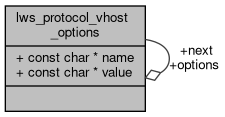
| struct lws_protocol_vhost_options |
struct lws_protocol_vhost_options - linked list of per-vhost protocol name=value options
This provides a general way to attach a linked-list of name=value pairs, which can also have an optional child link-list using the options member.
Definition at line 2092 of file lws-context-vhost.h.
| Data Fields | ||
|---|---|---|
| const struct lws_protocol_vhost_options * | next |
linked list |
| const struct lws_protocol_vhost_options * | options |
child linked-list of more options for this node |
| const char * | name |
name of name=value pair |
| const char * | value |
value of name=value pair |
| #define LWS_SERVER_OPTION_REQUIRE_VALID_OPENSSL_CLIENT_CERT |
#include <lws-context-vhost.h>
(VH) Don't allow the connection unless the client has a client cert that we recognize; provides LWS_SERVER_OPTION_DO_SSL_GLOBAL_INIT
Definition at line 46 of file lws-context-vhost.h.
| #define LWS_SERVER_OPTION_SKIP_SERVER_CANONICAL_NAME (1ll << 2) |
#include <lws-context-vhost.h>
(CTX) Don't try to get the server's hostname
Definition at line 51 of file lws-context-vhost.h.
| #define LWS_SERVER_OPTION_ALLOW_NON_SSL_ON_SSL_PORT |
#include <lws-context-vhost.h>
(VH) Allow non-SSL (plaintext) connections on the same port as SSL is listening. If combined with LWS_SERVER_OPTION_REDIRECT_HTTP_TO_HTTPS it will try to force http connections on an https listener (eg, http://x.com:443) to redirect to an explicit https connection (eg, https://x.com)
Definition at line 53 of file lws-context-vhost.h.
| #define LWS_SERVER_OPTION_LIBEV (1ll << 4) |
#include <lws-context-vhost.h>
(CTX) Use libev event loop
Definition at line 61 of file lws-context-vhost.h.
| #define LWS_SERVER_OPTION_DISABLE_IPV6 (1ll << 5) |
#include <lws-context-vhost.h>
(VH) Disable IPV6 support
Definition at line 63 of file lws-context-vhost.h.
| #define LWS_SERVER_OPTION_DISABLE_OS_CA_CERTS (1ll << 6) |
#include <lws-context-vhost.h>
(VH) Don't load OS CA certs, you will need to load your own CA cert(s)
Definition at line 65 of file lws-context-vhost.h.
| #define LWS_SERVER_OPTION_PEER_CERT_NOT_REQUIRED (1ll << 7) |
#include <lws-context-vhost.h>
(VH) Accept connections with no valid Cert (eg, selfsigned)
Definition at line 68 of file lws-context-vhost.h.
| #define LWS_SERVER_OPTION_VALIDATE_UTF8 (1ll << 8) |
#include <lws-context-vhost.h>
(VH) Check UT-8 correctness
Definition at line 70 of file lws-context-vhost.h.
| #define LWS_SERVER_OPTION_SSL_ECDH |
#include <lws-context-vhost.h>
(VH) initialize ECDH ciphers
Definition at line 72 of file lws-context-vhost.h.
| #define LWS_SERVER_OPTION_LIBUV (1ll << 10) |
#include <lws-context-vhost.h>
(CTX) Use libuv event loop
Definition at line 75 of file lws-context-vhost.h.
| #define LWS_SERVER_OPTION_REDIRECT_HTTP_TO_HTTPS |
#include <lws-context-vhost.h>
(VH) Use an http redirect to force the client to ask for https. Notice if your http server issues the STS header and the client has ever seen that, the client will fail the http connection before it can actually do the redirect.
Combine with LWS_SERVER_OPTION_REDIRECT_HTTP_TO_HTTPS to handle, eg, http://x.com:443 -> https://x.com
(deprecated: use mount redirection)
Definition at line 77 of file lws-context-vhost.h.
| #define LWS_SERVER_OPTION_DO_SSL_GLOBAL_INIT (1ll << 12) |
#include <lws-context-vhost.h>
(CTX) Initialize the SSL library at all
Definition at line 88 of file lws-context-vhost.h.
| #define LWS_SERVER_OPTION_EXPLICIT_VHOSTS (1ll << 13) |
#include <lws-context-vhost.h>
(CTX) Only create the context when calling context create api, implies user code will create its own vhosts
Definition at line 90 of file lws-context-vhost.h.
| #define LWS_SERVER_OPTION_UNIX_SOCK (1ll << 14) |
#include <lws-context-vhost.h>
(VH) Use Unix socket
Definition at line 93 of file lws-context-vhost.h.
| #define LWS_SERVER_OPTION_STS (1ll << 15) |
#include <lws-context-vhost.h>
(VH) Send Strict Transport Security header, making clients subsequently go to https even if user asked for http
Definition at line 95 of file lws-context-vhost.h.
| #define LWS_SERVER_OPTION_IPV6_V6ONLY_MODIFY (1ll << 16) |
#include <lws-context-vhost.h>
(VH) Enable LWS_SERVER_OPTION_IPV6_V6ONLY_VALUE to take effect
Definition at line 98 of file lws-context-vhost.h.
| #define LWS_SERVER_OPTION_IPV6_V6ONLY_VALUE (1ll << 17) |
#include <lws-context-vhost.h>
(VH) if set, only ipv6 allowed on the vhost
Definition at line 100 of file lws-context-vhost.h.
| #define LWS_SERVER_OPTION_UV_NO_SIGSEGV_SIGFPE_SPIN (1ll << 18) |
#include <lws-context-vhost.h>
(CTX) Libuv only: Do not spin on SIGSEGV / SIGFPE. A segfault normally makes the lib spin so you can attach a debugger to it even if it happened without a debugger in place. You can disable that by giving this option.
Definition at line 102 of file lws-context-vhost.h.
| #define LWS_SERVER_OPTION_JUST_USE_RAW_ORIGIN (1ll << 19) |
#include <lws-context-vhost.h>
For backwards-compatibility reasons, by default lws prepends "http://" to the origin you give in the client connection info struct. If you give this flag when you create the context, only the string you give in the client connect info for .origin (if any) will be used directly.
Definition at line 108 of file lws-context-vhost.h.
| #define LWS_SERVER_OPTION_FALLBACK_TO_RAW /* use below name */ (1ll << 20) |
#include <lws-context-vhost.h>
Definition at line 115 of file lws-context-vhost.h.
| #define LWS_SERVER_OPTION_FALLBACK_TO_APPLY_LISTEN_ACCEPT_CONFIG (1ll << 20) |
#include <lws-context-vhost.h>
(VH) if invalid http is coming in the first line, then abandon trying to treat the connection as http, and belatedly apply the .listen_accept_role / .listen_accept_protocol info struct members to the connection. If they are NULL, for backwards-compatibility the connection is bound to "raw-skt" role, and in order of priority: 1) the vh protocol with a pvo named "raw", 2) the vh protocol with a pvo named "default", or 3) protocols[0].
Must be combined with LWS_SERVER_OPTION_ALLOW_NON_SSL_ON_SSL_PORT to work with a socket listening with tls.
Definition at line 116 of file lws-context-vhost.h.
| #define LWS_SERVER_OPTION_LIBEVENT (1ll << 21) |
#include <lws-context-vhost.h>
(CTX) Use libevent event loop
Definition at line 129 of file lws-context-vhost.h.
| #define LWS_SERVER_OPTION_ONLY_RAW /* Use below name instead */ (1ll << 22) |
#include <lws-context-vhost.h>
Definition at line 132 of file lws-context-vhost.h.
| #define LWS_SERVER_OPTION_ADOPT_APPLY_LISTEN_ACCEPT_CONFIG (1ll << 22) |
#include <lws-context-vhost.h>
(VH) All connections to this vhost / port are bound to the role and protocol given in .listen_accept_role / .listen_accept_protocol.
If those explicit user-controlled names are NULL, for backwards- compatibility the connection is bound to "raw-skt" role, and in order of priority: 1) the vh protocol with a pvo named "raw", 2) the vh protocol with a pvo named "default", or 3) protocols[0].
It's much preferred to specify the role + protocol using the .listen_accept_role and .listen_accept_protocol in the info struct.
Definition at line 133 of file lws-context-vhost.h.
| #define LWS_SERVER_OPTION_ALLOW_LISTEN_SHARE (1ll << 23) |
#include <lws-context-vhost.h>
(VH) Set to allow multiple listen sockets on one interface + address + port. The default is to strictly allow only one listen socket at a time. This is automatically selected if you have multiple service threads. Linux only.
Definition at line 146 of file lws-context-vhost.h.
| #define LWS_SERVER_OPTION_CREATE_VHOST_SSL_CTX (1ll << 24) |
#include <lws-context-vhost.h>
(VH) Force setting up the vhost SSL_CTX, even though the user code doesn't explicitly provide a cert in the info struct. It implies the user code is going to provide a cert at the LWS_CALLBACK_OPENSSL_LOAD_EXTRA_SERVER_VERIFY_CERTS callback, which provides the vhost SSL_CTX * in the user parameter.
Definition at line 152 of file lws-context-vhost.h.
| #define LWS_SERVER_OPTION_SKIP_PROTOCOL_INIT (1ll << 25) |
#include <lws-context-vhost.h>
(VH) You probably don't want this. It forces this vhost to not call LWS_CALLBACK_PROTOCOL_INIT on its protocols. It's used in the special case of a temporary vhost bound to a single protocol.
Definition at line 159 of file lws-context-vhost.h.
| #define LWS_SERVER_OPTION_IGNORE_MISSING_CERT (1ll << 26) |
#include <lws-context-vhost.h>
(VH) Don't fail if the vhost TLS cert or key are missing, just continue. The vhost won't be able to serve anything, but if for example the ACME plugin was configured to fetch a cert, this lets you bootstrap your vhost from having no cert to start with.
Definition at line 164 of file lws-context-vhost.h.
| #define LWS_SERVER_OPTION_VHOST_UPG_STRICT_HOST_CHECK (1ll << 27) |
#include <lws-context-vhost.h>
(VH) On this vhost, if the connection is being upgraded, insist that there's a Host: header and that the contents match the vhost name + port (443 / 80 are assumed if no :port given based on if the connection is using TLS).
By default, without this flag, on upgrade lws just checks that the Host: header was given without checking the contents... this is to allow lax hostname mappings like localhost / 127.0.0.1, and CNAME mappings like www.mysite.com / mysite.com
Definition at line 170 of file lws-context-vhost.h.
| #define LWS_SERVER_OPTION_HTTP_HEADERS_SECURITY_BEST_PRACTICES_ENFORCE (1ll << 28) |
#include <lws-context-vhost.h>
(VH) Send lws default HTTP headers recommended by Mozilla Observatory for security. This is a helper option that sends canned headers on each http response enabling a VERY strict Content Security Policy. The policy is so strict, for example it won't let the page run its own inline JS nor show images or take CSS from a different server. In many cases your JS only comes from your server as do the image sources and CSS, so that is what you want... attackers hoping to inject JS into your DOM are completely out of luck since even if they succeed, it will be rejected for execution by the browser according to the strict CSP. In other cases you have to deviate from the complete strictness, in which case don't use this flag: use the .headers member in the vhost init described in struct lws_context_creation_info instead to send the adapted headers yourself.
Definition at line 181 of file lws-context-vhost.h.
| #define LWS_SERVER_OPTION_ALLOW_HTTP_ON_HTTPS_LISTENER (1ll << 29) |
#include <lws-context-vhost.h>
(VH) If you really want to allow HTTP connections on a tls listener, you can do it with this combined with LWS_SERVER_OPTION_ALLOW_NON_SSL_ON_SSL_PORT. But this is allowing accidental loss of the security assurances provided by tls depending on the client using http when he meant https... it's not recommended.
Definition at line 198 of file lws-context-vhost.h.
| #define LWS_SERVER_OPTION_FAIL_UPON_UNABLE_TO_BIND (1ll << 30) |
#include <lws-context-vhost.h>
(VH) When instantiating a new vhost and the specified port is already in use, a null value shall be return to signal the error.
Definition at line 206 of file lws-context-vhost.h.
| #define LWS_SERVER_OPTION_H2_JUST_FIX_WINDOW_UPDATE_OVERFLOW (1ll << 31) |
#include <lws-context-vhost.h>
(VH) Indicates the connections using this vhost should ignore h2 WINDOW_UPDATE from broken peers and fix them up
Definition at line 211 of file lws-context-vhost.h.
| #define LWS_SERVER_OPTION_VH_H2_HALF_CLOSED_LONG_POLL (1ll << 32) |
#include <lws-context-vhost.h>
(VH) Tell the vhost to treat half-closed remote clients as entered into an immortal (ie, not subject to normal timeouts) long poll mode.
Definition at line 215 of file lws-context-vhost.h.
| #define LWS_SERVER_OPTION_DISABLE_UTF8_VALIDATION (1ll << 34) |
#include <lws-context-vhost.h>
(VH) Disable UTF-8 validation of websocket TEXT frames. By default, TEXT frames are validated.
Definition at line 220 of file lws-context-vhost.h.
| #define LWS_SERVER_OPTION_GLIB (1ll << 33) |
#include <lws-context-vhost.h>
(CTX) Use glib event loop
Definition at line 227 of file lws-context-vhost.h.
| #define LWS_SERVER_OPTION_QUIC_FORCE_RETRY (1ll << 52) |
#include <lws-context-vhost.h>
(VH) For QUIC, force the server to always send a Retry packet. Normally used only for testing.
Definition at line 230 of file lws-context-vhost.h.
| #define LWS_SERVER_OPTION_H2_PRIOR_KNOWLEDGE (1ll << 34) |
#include <lws-context-vhost.h>
(VH) Tell the vhost to treat plain text http connections as H2 with prior knowledge (no upgrade request involved)
Definition at line 234 of file lws-context-vhost.h.
| #define LWS_SERVER_OPTION_NO_LWS_SYSTEM_STATES (1ll << 35) |
#include <lws-context-vhost.h>
(CTX) Disable lws_system state, eg, because we are a secure streams proxy client that is not trying to track system state by itself.
Definition at line 239 of file lws-context-vhost.h.
| #define LWS_SERVER_OPTION_SS_PROXY (1ll << 36) |
#include <lws-context-vhost.h>
(VH) We are being a SS Proxy listen socket for the vhost
Definition at line 243 of file lws-context-vhost.h.
| #define LWS_SERVER_OPTION_SDEVENT (1ll << 37) |
#include <lws-context-vhost.h>
(CTX) Use sd-event loop
Definition at line 246 of file lws-context-vhost.h.
| #define LWS_SERVER_OPTION_ULOOP (1ll << 38) |
#include <lws-context-vhost.h>
(CTX) Use libubox / uloop event loop
Definition at line 249 of file lws-context-vhost.h.
| #define LWS_SERVER_OPTION_DISABLE_TLS_SESSION_CACHE (1ll << 39) |
#include <lws-context-vhost.h>
(VHOST) Disallow use of client tls caching (on by default)
Definition at line 252 of file lws-context-vhost.h.
| #define LWS_SERVER_OPTION_OPENSSL_AUTO_DH_PARAMETERS (1ll << 40) |
#include <lws-context-vhost.h>
Configure openssl to use the default built-in DH parameters to support TLSv1.2 Kx=DH ciphers (by calling SSL_CTX_set_dh_auto) This is needed when you want to enable TLSv1.2 ephemeral Diffie-Hellman (DH) key exchange ciphers (e.g. TLS_DHE_RSA_WITH_AES_256_GCM_SHA384). It's not recommended.
Definition at line 255 of file lws-context-vhost.h.
| #define LWS_SERVER_OPTION_MBEDTLS_VERIFY_CLIENT_CERT_POST_HANDSHAKE |
#include <lws-context-vhost.h>
(VH) An option to be used with mbedtls only, forces server to load and store the client cert (without CA dependent check) to be able to verify it later (after the handshake); provides LWS_SERVER_OPTION_DO_SSL_GLOBAL_INIT. Note: LWS_SERVER_OPTION_REQUIRE_VALID_OPENSSL_CLIENT_CERT and LWS_SERVER_OPTION_PEER_CERT_NOT_REQUIRED are ignored if LWS_SERVER_OPTION_MBEDTLS_VERIFY_CLIENT_CERT_POST_HANDSHAKE is set
Definition at line 262 of file lws-context-vhost.h.
| #define LWS_SERVER_OPTION_VH_INSTANTIATE_ALL_PROTOCOLS (1ll << 42) |
#include <lws-context-vhost.h>
(VH) force instantiation of all protocols for this vhost
Definition at line 272 of file lws-context-vhost.h.
| #define LWS_SERVER_OPTION_VH_SKIP_PRIV_DROP (1ll << 43) |
#include <lws-context-vhost.h>
Cause create vhost api to skip priv drop, requires caller to manage it themselves
Definition at line 275 of file lws-context-vhost.h.
| #define LWS_SERVER_OPTION_CMDLINE_FORCE_H1 (1ll << 44) |
#include <lws-context-vhost.h>
(CTX) Set by core built-in options to force ALPN to HTTP/1.1
Definition at line 279 of file lws-context-vhost.h.
| #define LWS_SERVER_OPTION_CMDLINE_FORCE_H2 (1ll << 45) |
#include <lws-context-vhost.h>
(CTX) Set by core built-in options to force ALPN to H2
Definition at line 282 of file lws-context-vhost.h.
| #define LWS_SERVER_OPTION_CMDLINE_FORCE_H3 (1ll << 46) |
#include <lws-context-vhost.h>
(CTX) Set by core built-in options to force ALPN to H3
Definition at line 285 of file lws-context-vhost.h.
| #define LWS_SERVER_OPTION_ALLOW_EARLY_DATA (1ll << 47) |
#include <lws-context-vhost.h>
(VH) Accept 0-RTT early data for QUIC/TLS 1.3 connections. Only gnutls builds honour it. A gnutls older than 3.8.4 accepts none over QUIC: those gnutls crash a server that takes it. The openssl-family backends never accept it, lws having no replay protection for early data there
Definition at line 288 of file lws-context-vhost.h.
| #define LWS_SERVER_OPTION_CPD_BYPASS (1ll << 48) |
#include <lws-context-vhost.h>
(CTX) Bypass Captive Portal Detection and immediately assume internet is OK
Definition at line 295 of file lws-context-vhost.h.
| #define LWS_SERVER_OPTION_QUIC_PAD_CRYPTO (1ll << 49) |
#include <lws-context-vhost.h>
(VH) Pad the QUIC handshake crypto data to artificially hit anti-amplification limits
Definition at line 298 of file lws-context-vhost.h.
| #define LWS_SERVER_OPTION_QUIC_EARLY_KEY_UPDATE (1ll << 51) |
#include <lws-context-vhost.h>
CONTEXT: For testing. Trigger a QUIC early key update
Definition at line 301 of file lws-context-vhost.h.
| #define LWS_SERVER_OPTION_QUIC_LATEST_VERSION (1ll << 50) |
#include <lws-context-vhost.h>
(CTX) Force client to initiate QUIC connections using the latest supported version (e.g. v2)
Definition at line 304 of file lws-context-vhost.h.
| #define LWS_SERVER_OPTION_SNI_FALLBACK (1ll << 53) |
#include <lws-context-vhost.h>
(VH) This vhost is the fallback for TLS connections arriving on its listen port with an SNI name that matches no vhost there. Without a vhost marked like this on the port, an unrecognized SNI name is refused with a fatal unrecognized_name alert rather than being served by whichever vhost happens to be first on the port, since that would decide the certificate shown and the client certificate policy applied by vhost creation order. Connections that send no SNI at all are not affected either way, they stay on the vhost that accepted them.
Definition at line 307 of file lws-context-vhost.h.
| #define LWS_SERVER_OPTION_DISABLE_IPV4 (1ll << 54) |
#include <lws-context-vhost.h>
(VH) Disable IPV4 support, eg, to force ipv6-only operation (the -6 commandline switch sets this at context level). This is the mirror of LWS_SERVER_OPTION_DISABLE_IPV6: DNS results for the disabled family are filtered out and no listeners are created for it
Definition at line 318 of file lws-context-vhost.h.
| #define LWS_SERVER_OPTION_NO_HTTP_STREAM_COMPRESSION (1ll << 55) |
#include <lws-context-vhost.h>
(VH) This vhost never compresses its http responses on the fly (LWS_WITH_HTTP_STREAM_COMPRESSION), whatever the client's Accept-Encoding, eg, where responses mix secrets with what the client controls and compression would leak them (BREACH). Its responses do not depend on Accept-Encoding then, so they carry no "vary: accept-encoding" for it either. Files served already gzipped from a zip are not affected
Definition at line 325 of file lws-context-vhost.h.
| #define lws_check_opt | ( | c, | |
| f ) |
#include <lws-context-vhost.h>
Definition at line 337 of file lws-context-vhost.h.
| #define LWS_PT_SERV_BUF_SIZE_MAX (16u * 1024u * 1024u) |
#include <lws-context-vhost.h>
Definition at line 371 of file lws-context-vhost.h.
| #define LWS_FD_LIMIT_INTERNAL_NETLINK 0 |
#include <lws-context-vhost.h>
struct lws_context_creation_info - parameters to create context and /or vhost with
This is also used to create vhosts.... if LWS_SERVER_OPTION_EXPLICIT_VHOSTS is not given, then for backwards compatibility one vhost is created at context-creation time using the info from this struct.
If LWS_SERVER_OPTION_EXPLICIT_VHOSTS is given, then no vhosts are created at the same time as the context, they are expected to be created afterwards.
Definition at line 410 of file lws-context-vhost.h.
| #define LWS_FD_LIMIT_INTERNAL_ADNS 0 |
#include <lws-context-vhost.h>
Definition at line 415 of file lws-context-vhost.h.
| #define LWS_FD_LIMIT_INTERNAL_NTP 0 |
#include <lws-context-vhost.h>
Definition at line 420 of file lws-context-vhost.h.
| #define LWS_FD_LIMIT_INTERNAL_DHCP 0 |
#include <lws-context-vhost.h>
Definition at line 425 of file lws-context-vhost.h.
| #define LWS_FD_LIMIT_INTERNAL |
#include <lws-context-vhost.h>
Definition at line 428 of file lws-context-vhost.h.
| #define LWS_FD_LIMIT_PER_THREAD_MIN (LWS_FD_LIMIT_INTERNAL + 8 /* overhead */) |
#include <lws-context-vhost.h>
Definition at line 434 of file lws-context-vhost.h.
| #define LWS_HTTP_BODY_MIN_RATE_NONE 0xffffffffu |
#include <lws-context-vhost.h>
Definition at line 437 of file lws-context-vhost.h.
| #define LWS_MUX_RESET_LIMIT_NONE 0xffffu |
#include <lws-context-vhost.h>
Definition at line 439 of file lws-context-vhost.h.
| typedef int(* lws_context_ready_cb_t) (struct lws_context *context) |
#include <lws-context-vhost.h>
Definition at line 345 of file lws-context-vhost.h.
| typedef uint64_t(* lws_quic_tx_credit_cb_t) (struct lws *wsi, uint64_t current_window, uint64_t consumed_bytes, uint64_t time_since_last_update_us) |
#include <lws-context-vhost.h>
lws_quic_tx_credit_cb_t - Callback for dynamic QUIC TX credit window scaling
| wsi | The stream wsi, or the network wsi for connection-level flow control |
| current_window | The current window size (rx_window_size) |
| consumed_bytes | The number of bytes the application just consumed |
| time_since_last_update_us | Microseconds since the window was last scaled or initialized |
Return: The new window size (in bytes). If you return 0 or a value less than the current ungranted window, the window will not be scaled.
Definition at line 364 of file lws-context-vhost.h.
| typedef int(* lws_reload_func) (void) |
#include <lws-context-vhost.h>
Definition at line 1649 of file lws-context-vhost.h.
| LWS_VISIBLE LWS_EXTERN struct lws_context * lws_create_context | ( | const struct lws_context_creation_info * | info | ) |
#include <lws-context-vhost.h>
lws_create_context() - Create the websocket handler
| info | pointer to struct with parameters This function creates the listening socket (if serving) and takes care of all initialization in one step. If option LWS_SERVER_OPTION_EXPLICIT_VHOSTS is given, no vhost is created; you're expected to create your own vhosts afterwards using lws_create_vhost(). Otherwise a vhost named "default" is also created using the information in the vhost-related members, for compatibility. After initialization, it returns a struct lws_context * that represents this server. After calling, user code needs to take care of calling lws_service() with the context pointer to get the server's sockets serviced. This must be done in the same process context as the initialization call. The protocol callback functions are called for a handful of events including http requests coming in, websocket connections becoming established, and data arriving; it's also called periodically to allow async transmission. HTTP requests are sent always to the FIRST protocol in protocol, since at that time websocket protocol has not been negotiated. Other protocols after the first one never see any HTTP callback activity. The server created is a simple http server by default; part of the websocket standard is upgrading this http connection to a websocket one. This allows the same server to provide files like scripts and favicon / images or whatever over http and dynamic data over websockets all in one place; they're all handled in the user callback. |
References LWS_EXTERN, and LWS_VISIBLE.
| LWS_VISIBLE LWS_EXTERN void lws_context_destroy | ( | struct lws_context * | context | ) |
#include <lws-context-vhost.h>
lws_context_destroy() - Destroy the websocket context
| context | Websocket context This function closes any active connections and then frees the context. After calling this, any further use of the context is undefined. |
References LWS_EXTERN, and LWS_VISIBLE.
| LWS_VISIBLE LWS_EXTERN void lws_tls_cleanup_process | ( | void | ) |
#include <lws-context-vhost.h>
lws_tls_cleanup_process() - cleanup process-wide TLS allocations
 This function can be called after the last context is destroyed to
 cleanup process-wide TLS allocations. For example, for OpenSSL it
 may call OPENSSL_cleanup() if supported.
 You should only call this if you are absolutely sure you will not
 reinitialize libwebsockets or the TLS library in this process.
| LWS_VISIBLE LWS_EXTERN void lws_context_deprecate | ( | struct lws_context * | context, |
| lws_reload_func | cb ) |
#include <lws-context-vhost.h>
lws_context_deprecate() - Deprecate the websocket context
| context | Websocket context |
| cb | Callback notified when old context listen sockets are closed This function is used on an existing context before superceding it with a new context. It closes any listen sockets in the context, so new connections are not possible. And it marks the context to be deleted when the number of active connections into it falls to zero. This is aimed at allowing seamless configuration reloads. The callback cb will be called after the listen sockets are actually closed and may be reopened. In the callback the new context should be configured and created. (With libuv, socket close happens async after more loop events). |
References LWS_EXTERN, and LWS_VISIBLE.
| LWS_VISIBLE LWS_EXTERN int lws_context_is_deprecated | ( | struct lws_context * | context | ) |
#include <lws-context-vhost.h>
References LWS_EXTERN, and LWS_VISIBLE.
| LWS_VISIBLE LWS_EXTERN int lws_set_proxy | ( | struct lws_vhost * | vhost, |
| const char * | proxy ) |
#include <lws-context-vhost.h>
lws_set_proxy() - Setups proxy to lws_context.
| vhost | pointer to struct lws_vhost you want set proxy for |
| proxy | pointer to c string containing proxy in format address:port |
Returns 0 if proxy string was parsed and proxy was setup. Returns -1 if proxy is NULL or has incorrect format.
This is only required if your OS does not provide the http_proxy environment variable (eg, OSX)
IMPORTANT! You should call this function right after creation of the lws_context and before call to connect. If you call this function after connect behavior is undefined. This function will override proxy settings made on lws_context creation with genenv() call.
References LWS_EXTERN, and LWS_VISIBLE.
| LWS_VISIBLE LWS_EXTERN int lws_set_socks | ( | struct lws_vhost * | vhost, |
| const char * | socks ) |
#include <lws-context-vhost.h>
lws_set_socks() - Setup socks to lws_context.
| vhost | pointer to struct lws_vhost you want set socks for |
| socks | pointer to c string containing socks in format address:port |
Returns 0 if socks string was parsed and socks was setup. Returns -1 if socks is NULL or has incorrect format.
This is only required if your OS does not provide the socks_proxy environment variable (eg, OSX)
IMPORTANT! You should call this function right after creation of the lws_context and before call to connect. If you call this function after connect behavior is undefined. This function will override proxy settings made on lws_context creation with genenv() call.
References LWS_EXTERN, and LWS_VISIBLE.
| LWS_VISIBLE LWS_EXTERN struct lws_vhost * lws_create_vhost | ( | struct lws_context * | context, |
| const struct lws_context_creation_info * | info ) |
#include <lws-context-vhost.h>
lws_create_vhost() - Create a vhost (virtual server context)
| context | pointer to result of lws_create_context() |
| info | pointer to struct with parameters |
This function creates a virtual server (vhost) using the vhost-related members of the info struct. You can create many vhosts inside one context if you created the context with the option LWS_SERVER_OPTION_EXPLICIT_VHOSTS
References LWS_EXTERN, and LWS_VISIBLE.
| LWS_VISIBLE LWS_EXTERN void lws_vhost_destroy | ( | struct lws_vhost * | vh | ) |
#include <lws-context-vhost.h>
lws_vhost_destroy() - Destroy a vhost (virtual server context)
| vh | pointer to result of lws_create_vhost() |
This function destroys a vhost. Normally, if you just want to exit, then lws_destroy_context() will take care of everything. If you want to destroy an individual vhost and all connections and allocations, you can do it with this.
If the vhost has a listen sockets shared by other vhosts, it will be given to one of the vhosts sharing it rather than closed.
The vhost close is staged according to the needs of the event loop, and if there are multiple service threads. At the point the vhost itself if about to be freed, if you provided a finalize callback and optional arg at vhost creation time, it will be called just before the vhost is freed.
| LWS_VISIBLE LWS_EXTERN int lwsws_get_config_globals | ( | struct lws_context_creation_info * | info, |
| const char * | d, | ||
| char ** | config_strings, | ||
| int * | len ) |
#include <lws-context-vhost.h>
lwsws_get_config_globals() - Parse a JSON server config file
| info | pointer to struct with parameters |
| d | filepath of the config file |
| config_strings | storage for the config strings extracted from JSON, the pointer is incremented as strings are stored |
| len | pointer to the remaining length left in config_strings the value is decremented as strings are stored |
This function prepares a n lws_context_creation_info struct with global settings from a file d.
If the config strings arena is too small for the parsed content, the parse fails and nonzero is returned.
The JSON is preprocessed for scoped substitution defines: pairs whose name starts with '=' define a symbol scoped to the object they appear in (visible until the object closes, ie, defines at the root of the file apply for the rest of that file), and ${NAME} sequences in string values are expanded from the visible defines before the values are used. It is a parse error to reference an undefined symbol, to use an invalid define name, or to give a define a non-string value.
This variant parses with a fresh set of defines. Use lwsws_get_config_globals_defs() if you want root defines to stay visible when the vhosts config is parsed later.
Requires CMake option LWS_WITH_LEJP_CONF to have been enabled
References LWS_EXTERN, and LWS_VISIBLE.
| LWS_VISIBLE LWS_EXTERN int lwsws_get_config_globals_defs | ( | struct lws_lejp_conf_defs * | defs, |
| struct lws_context_creation_info * | info, | ||
| const char * | d, | ||
| char ** | config_strings, | ||
| int * | len ) |
#include <lws-context-vhost.h>
lwsws_get_config_globals_defs() - Parse a JSON server config file
| defs | caller's install-wide defines container, zeroed to initialize; defines created in the "global" section of the walked files accumulate into it |
| info | pointer to struct with parameters |
| d | filepath of the config file |
| config_strings | storage for the config strings extracted from JSON, the pointer is incremented as strings are stored |
| len | pointer to the remaining length left in config_strings the value is decremented as strings are stored |
Behaves as lwsws_get_config_globals(), except that defines created in the "global" section of the walked files accumulate into defs, so they are visible in later walked files, and can be made visible to a later vhosts config walk by passing the same defs to lwsws_get_config_vhosts_defs(). Destroy defs with lwsac_free(&defs->ac) after the last config walk that uses it.
Requires CMake option LWS_WITH_LEJP_CONF to have been enabled
References LWS_EXTERN, and LWS_VISIBLE.
| LWS_VISIBLE LWS_EXTERN int lwsws_get_config_vhosts | ( | struct lws_context * | context, |
| struct lws_context_creation_info * | info, | ||
| const char * | d, | ||
| char ** | config_strings, | ||
| int * | len ) |
#include <lws-context-vhost.h>
lwsws_get_config_vhosts() - Create vhosts from a JSON server config file
| context | pointer to result of lws_create_context() |
| info | pointer to struct with parameters |
| d | filepath of the config file |
| config_strings | storage for the config strings extracted from JSON, the pointer is incremented as strings are stored |
| len | pointer to the remaining length left in config_strings the value is decremented as strings are stored |
This function creates vhosts into a context according to the settings in JSON files found in directory d.
If the config strings arena is too small for the parsed content, the parse fails and nonzero is returned.
The JSON is preprocessed for scoped substitution defines as described at lwsws_get_config_globals().
This variant parses each file with a fresh set of defines. Use lwsws_get_config_vhosts_defs() with the same defs container filled by lwsws_get_config_globals_defs() to have the globals config defines stay visible in the vhost files.
Requires CMake option LWS_WITH_LEJP_CONF to have been enabled
References LWS_EXTERN, and LWS_VISIBLE.
| LWS_VISIBLE LWS_EXTERN int lwsws_get_config_vhosts_defs | ( | struct lws_lejp_conf_defs * | defs, |
| struct lws_context * | context, | ||
| struct lws_context_creation_info * | info, | ||
| const char * | d, | ||
| char ** | config_strings, | ||
| int * | len ) |
#include <lws-context-vhost.h>
lwsws_get_config_vhosts_defs() - Create vhosts from a JSON server config file, with install-wide defines
| defs | caller's install-wide defines container previously filled by lwsws_get_config_globals_defs(); the defines in it are visible (read-only) in every walked file |
| context | pointer to result of lws_create_context() |
| info | pointer to struct with parameters |
| d | filepath of the config file |
| config_strings | storage for the config strings extracted from JSON, the pointer is incremented as strings are stored |
| len | pointer to the remaining length left in config_strings the value is decremented as strings are stored |
Behaves as lwsws_get_config_vhosts(), except that the defines in defs are visible in every walked file, where file-local defines may shadow them. Defines created in the walked files themselves remain scoped to the file they were created in. Destroy defs with lwsac_free(&defs->ac) after this returns, when no further config walk will use it.
Requires CMake option LWS_WITH_LEJP_CONF to have been enabled
References LWS_EXTERN, and LWS_VISIBLE.
| LWS_VISIBLE LWS_EXTERN struct lws_vhost * lws_get_vhost | ( | struct lws * | wsi | ) |
#include <lws-context-vhost.h>
lws_get_vhost() - return the vhost a wsi belongs to
| wsi | which connection |
References LWS_EXTERN, and LWS_VISIBLE.
| LWS_VISIBLE LWS_EXTERN const char * lws_get_vhost_name | ( | struct lws_vhost * | vhost | ) |
#include <lws-context-vhost.h>
lws_get_vhost_name() - returns the name of a vhost
| vhost | which vhost |
References LWS_EXTERN, and LWS_VISIBLE.
| LWS_VISIBLE LWS_EXTERN struct lws_vhost * lws_get_vhost_by_name | ( | struct lws_context * | context, |
| const char * | name ) |
#include <lws-context-vhost.h>
lws_get_vhost_by_name() - returns the vhost with the requested name, or NULL
| context | the lws_context to look in |
| name | vhost name we are looking for |
Returns NULL, or the vhost with the name name
References LWS_EXTERN, and LWS_VISIBLE.
| LWS_VISIBLE LWS_EXTERN struct lws_vhost * lws_select_vhost_sni | ( | struct lws_vhost * | lv, |
| const char * | servername ) |
#include <lws-context-vhost.h>
lws_select_vhost_sni() - vhost for a TLS SNI name, or NULL to refuse him
| lv | the vhost that accepted the connection |
| servername | the SNI name the peer sent, NUL-terminated |
The candidates are only the vhosts served by the listener the connection arrived on, ie, lv and the vhosts sharing its listen socket: the same port and interface. A vhost on the same port but another interface is never selected, since its interface may be all that restricts who can reach it.
Returns the candidate whose name matches servername exactly, or failing that the one that a *.name wildcard match resolves to, or failing that the one marked LWS_SERVER_OPTION_SNI_FALLBACK, if any, or failing that the only candidate, if there is just the one.
Returns NULL if the name matches no vhost on the listener and no fallback vhost was nominated there. In that case the caller must refuse the connection with a fatal unrecognized_name alert: continuing on an arbitrary vhost would let the peer choose which certificate he is shown, and which client certificate policy he meets, by naming something that does not exist.
This is only for the TLS SNI decision. Selecting a vhost from a Host: header after the connection is up is a different question with a different answer, since a server with a single vhost is reached by IP address all the time.
References LWS_EXTERN, and LWS_VISIBLE.
| LWS_VISIBLE LWS_EXTERN int lws_get_vhost_port | ( | struct lws_vhost * | vhost | ) |
#include <lws-context-vhost.h>
lws_get_vhost_port() - returns the port a vhost listens on, or -1
| vhost | which vhost |
References LWS_EXTERN, and LWS_VISIBLE.
| LWS_VISIBLE LWS_EXTERN void * lws_get_vhost_user | ( | struct lws_vhost * | vhost | ) |
#include <lws-context-vhost.h>
lws_get_vhost_user() - returns the user pointer for the vhost
| vhost | which vhost |
References LWS_EXTERN, and LWS_VISIBLE.
| LWS_VISIBLE LWS_EXTERN const char * lws_get_vhost_iface | ( | struct lws_vhost * | vhost | ) |
#include <lws-context-vhost.h>
lws_get_vhost_iface() - returns the binding for the vhost listen socket
| vhost | which vhost |
References LWS_EXTERN, and LWS_VISIBLE.
| LWS_VISIBLE LWS_EXTERN void * lws_vhost_user | ( | struct lws_vhost * | vhost | ) |
#include <lws-context-vhost.h>
lws_vhost_user() - get the user data associated with the vhost
| vhost | Websocket vhost |
This returns the optional user pointer that can be attached to a vhost when it was created. Lws never dereferences this pointer, it only sets it when the vhost is created, and returns it using this api.
References LWS_EXTERN, and LWS_VISIBLE.
| LWS_VISIBLE LWS_EXTERN void * lws_context_user | ( | struct lws_context * | context | ) |
#include <lws-context-vhost.h>
lws_context_user() - get the user data associated with the context
| context | Websocket context |
This returns the optional user allocation that can be attached to the context the sockets live in at context_create time. It's a way to let all sockets serviced in the same context share data without using globals statics in the user code.
References LWS_EXTERN, and LWS_VISIBLE.
| LWS_VISIBLE LWS_EXTERN const char * lws_vh_tag | ( | struct lws_vhost * | vh | ) |
#include <lws-context-vhost.h>
References LWS_EXTERN, and LWS_VISIBLE.
| LWS_VISIBLE LWS_EXTERN void _lws_context_info_defaults | ( | struct lws_context_creation_info * | info, |
| const char * | sspol ) |
#include <lws-context-vhost.h>
lws_context_info_defaults() - zero and prepare a context creation info
| info | the creation info struct to initialize |
| sspol | the Secure Streams JSON policy to use, or NULL |
Zeroes info and sets defaults suited to a small client: no listen port, LWS_SERVER_OPTION_EXPLICIT_VHOSTS, LWS_SERVER_OPTION_DO_SSL_GLOBAL_INIT, the policy (when Secure Streams are built) and the small fd lookup scheme with fd_limit_per_thread = LWS_FD_LIMIT_PER_THREAD_MIN + 6.
That fds table, which also sizes the http header pool, is plenty for a client with a few connections, but a server started from these defaults stops accepting on all of its listeners once the table is full, until something closes: a handful of idle connections is enough. After calling this, set info->fd_limit_per_thread to LWS_FD_LIMIT_PER_THREAD_MIN plus the number of connections you mean to have open, or to 0 to size the tables to the process fd limit, which is what a server wants.
References LWS_EXTERN, and LWS_VISIBLE.
| LWS_VISIBLE LWS_EXTERN void lws_default_loop_exit | ( | struct lws_context * | cx | ) |
#include <lws-context-vhost.h>
lws_default_loop_exit() - ask lws_context_default_loop_run_destroy() to end
| cx | the lws context |
Safe to call from a signal handler or from any lws callback, and the recommended way for an app that owns its service loop to stop: lws_service() returns -1 afterwards, so the app leaves its loop and calls lws_context_destroy(). On the default poll loop nothing else happens until then. On an event library's internal loop (eg, LWS_SERVER_OPTION_LIBUV without a foreign loop) it starts the context destroy from inside the service, which winds the loop down so that lws_service() returns -1, and the app's lws_context_destroy() finalizes it. lws_context_default_loop_run_destroy() is that loop and final call in one helper.
When lws is a guest on a foreign loop there is no lws loop to leave: the off-ramp there is lws_context_destroy(), which detaches from the loop asynchronously and clears info.pcontext when lws has gone, while the loop itself carries on.
References LWS_EXTERN, and LWS_VISIBLE.
| LWS_VISIBLE LWS_EXTERN void lws_context_default_loop_run_destroy | ( | struct lws_context * | cx | ) |
#include <lws-context-vhost.h>
References LWS_EXTERN, and LWS_VISIBLE.
| LWS_VISIBLE LWS_EXTERN int lws_cmdline_passfail | ( | int | argc, |
| const char ** | argv, | ||
| int | actual ) |
#include <lws-context-vhost.h>
References LWS_EXTERN, and LWS_VISIBLE.
| LWS_VISIBLE LWS_EXTERN int lws_systemd_inherited_fd | ( | unsigned int | index, |
| struct lws_context_creation_info * | info ) |
#include <lws-context-vhost.h>
lws_systemd_inherited_fd() - prepare vhost creation info for systemd exported fd if any
| index | 0+ index of exported fd |
| info | info struct to be prepared with related info, if any |
Returns 0 and points info to the related fd, aligning the other information to the type of fd and port it is bound to, or returns nonzero if no such inherited fd.
References LWS_EXTERN, and LWS_VISIBLE.
| LWS_VISIBLE LWS_EXTERN int lws_context_is_being_destroyed | ( | struct lws_context * | context | ) |
#include <lws-context-vhost.h>
lws_context_is_being_destroyed() - find out if context is being destroyed
| context | the struct lws_context pointer |
Returns nonzero if the context has had lws_context_destroy() called on it... when using event library loops the destroy process can be asynchronous. In the special case of libuv foreign loops, the failure to create the context may have to do work on the foreign loop to reverse the partial creation, meaning a failed context create cannot unpick what it did and return NULL.
In that condition, a valid context that is already started the destroy process is returned, and this test api will return nonzero as a way to find out the create is in the middle of failing.
 1.18.0